on
The Fates
A week or so ago, I watched the honestly excellent documentary from People Make Games about Jerry Gretzinger, an artist who works on a staggeringly large map of a fictional place. He does this by means of a deck of cards1 that, in the end, amount to an analogue procedural algorithm for how to modify the map. He draws a card, and does what it says - add a town here, add a new panel there, and so on.
I kept thinking about that deck of cards long after I finished the documentary. It made it very straightforward for Jerry to work on the map: he’d draw a card, and do what it said. If he didn’t like the effect it had, he’d alter the rules, or the deck. But the next step after was always to draw another card and follow its instructions.
Now, I have struggled for my entire life to tie together the various creative interests I have, from music composition, to visual arts, to woodworking and carpentry, to writing fiction and non-fiction, to cooking and baking. They all feel relatively cohesive to me, in that they’re all trying to create something. The different outputs and types are just differences in methodology.
So, I followed another time-honoured journey of creative people: stealing. I stole the idea behind Jerry’s deck of cards: that it’s a draw-one, self-modifying, self-regulating deck for creating stuff, and decided I’d make my own. I also decided to lean into whimsy and pathos, and so I came up with The Fates.
The Fates
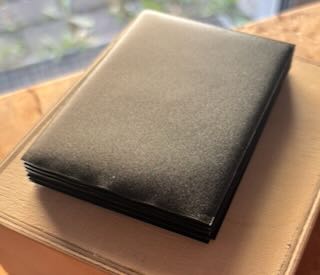
The Fates are a deck of, currently, 15 directives, or Fates. They are cut-together pieces of heavy note-paper, with a reversed Magic: The Gathering card as backing, inside cheap sleeves that I had lying around. Why? Because one of the directives is to shuffle the deck, and M:TG cards shuffle nicely.
This silly deck of cards has been extraordinarily successful for me at making more stuff. It is very straightforward to make more stuff with. It has three rules:
- To invoke The Fates, draw a card off the top. Follow their instructions.
- After you have completed said instructions, place the card at the bottom of the pile.
- When you invoke The Fates, write down which Fate has been bestowed upon you. Then write down what you did to execute it.
And so, when I sit down at my desk with nothing concretely to do, rather than launch a video game of my choice2, I Invoke The Fates™. And it has just led to me making a ton of stuff and having altogether better wellbeing than I did prior to trying this out. I’d recommend giving it a shot, if choice-paralysis in the creating of stuff is a thing that affects you.
In closing, here’s a list of my cards, currently:
- Shuffle.
- Read a chapter of fiction.
- Read a chapter of non-fiction.
- Invoke The Fates(™) and embellish their command (read: Draw on the card.)
- Meditate about The Fates (what’s working? What isn’t? Am I happy with how this experiment is going?)
- Meditate about the forefront of your mind (basically: actually run down and finish thinking about what’s in your head, rather than leaving it open and then getting distracted)
- Add A Fate
- Invoke The Fates and add a footnote/clarification/exception to it.
- The World demands maintenance: do a chore.
- The World demands a visitation: Take a walk. (this was the last initial card of 10, the next 5 have been added via Fate #7)
- The Fates Demand Cleansing (clean/dust/maintain your workspace/desk)
- Write about an idea, in private (This takes the form of, usually, a half-page in my logbook and takes surprisingly little time to actually come up with one, they’ve all been pretty good and useful)
- Process Some Notes (see my old post about what I mean with this)
- Make a box (This is, roughly, woodworking meditation for me. I make many boxes of varying size. It’s been great)
- Invent a Location and write about it. (this is basically just a creative writing prompt, a small thing I like doing occasionally since I read Calvino’s Invisible Cities)
-
The more precise mechanics of this deck of cards are actually public! Jerry’s website outlines the process. ↩
-
Usually Deadlock, honestly. ↩